

Rare combination of Early Mining, Motor Cars and Music. Beautiful stock certificate from the Big Four Gold and Copper Mining issued in 1899. This historic document has an ornate border around it with 3 vignettes: top center of mill buildings in rugged canyon with river and steam train; top left of 3 miners inspecting ore sample; top right of miners working underground. This item has the signatures of the Company's President, Jerome H. Remick and Secretary, John W. Henney and is over 122 years old. The certificate was issued to John W. Henney and was signed on the back in 1927 by John W. Henney, Jr., as Executor of John W. Henney, Sr.'s Estate. 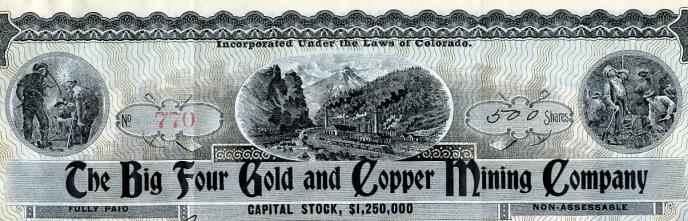
Certificate Vignette 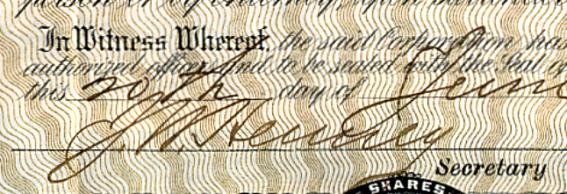
John W. Henney's Signature as Secretary 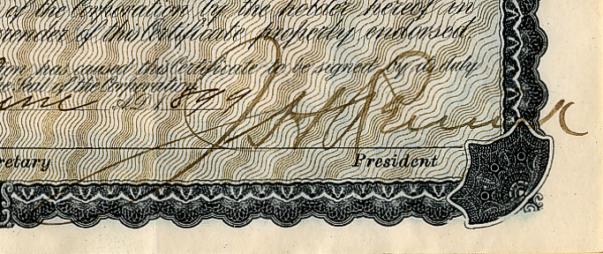
Jerome H. Remick's Signature as President 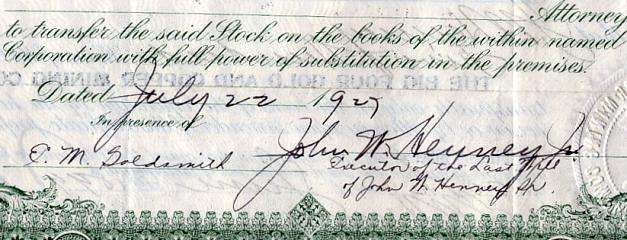
John W. Henney, Jr.'s Signature on Back 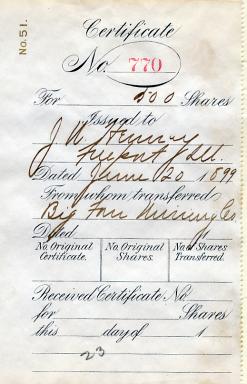
Certificate Ledger Stub referring to Freeport, Illinois The Big Four Gold and Copper Mining Co. was incorporated in Colorado and operated in Leadville. They owned claims covering 11 acres north of the Little Jonnie Mine in the Leadville district. Jerome H. Remick The president of the company was Jerome H. Remick , music publisher; born, Detroit, Nov. 15, 1867; son of James A. and Mary (Hosmer Remick; common school education; married at Flint, Mich., June 26, 1895, Miss Adelaide McCreery. Began active career in banking business in Detroit and was president of J.H. Remick & Co; president The J.H. Remick Printing Co. and the Big Four Gold and Copper Mining Co. 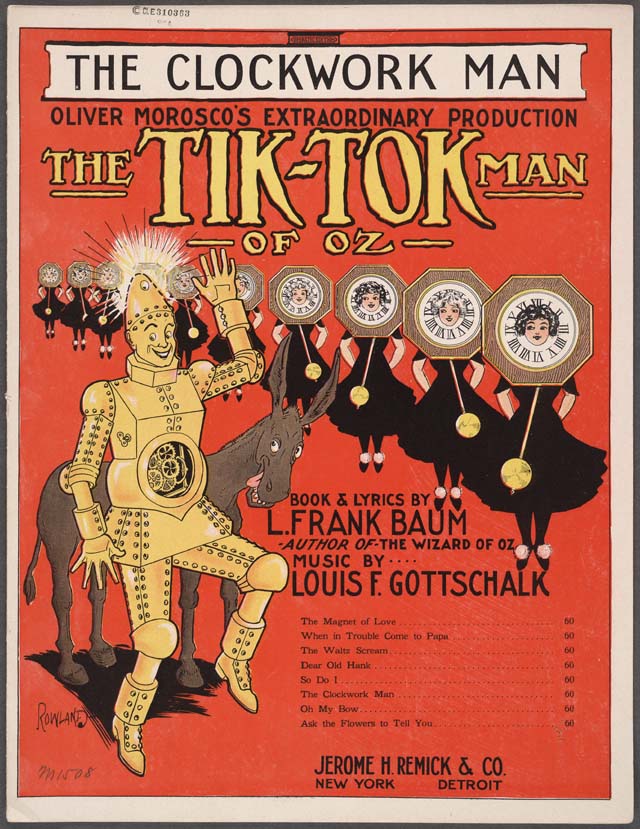
Example of Jerome H. Remick's Sheet Music - Shown for illustrative Purposes 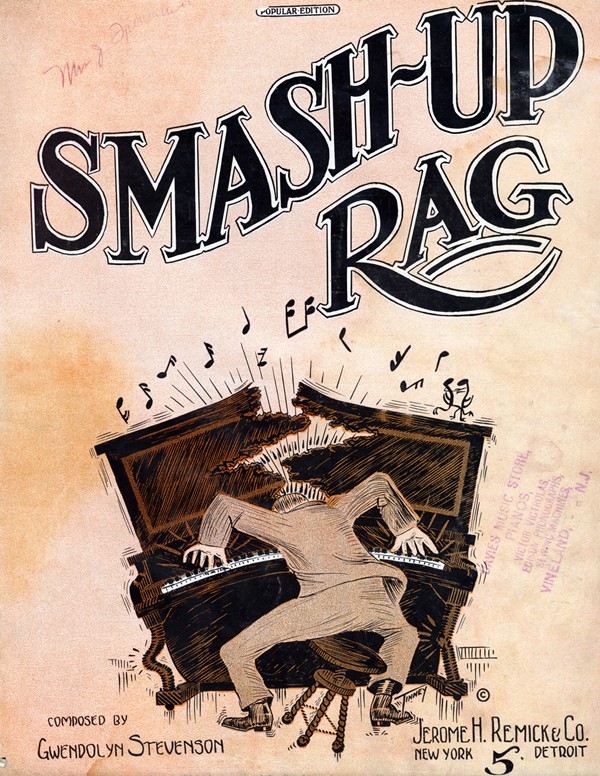
Example of Jerome H. Remick's Sheet Music - Shown for illustrative Purposes 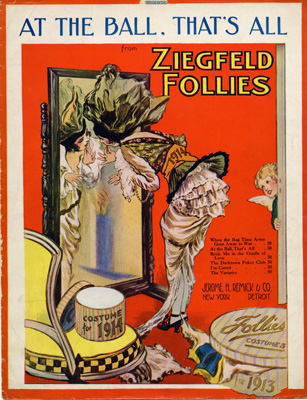
Example of Jerome H. Remick's Sheet Music - Shown for illustrative Purposes 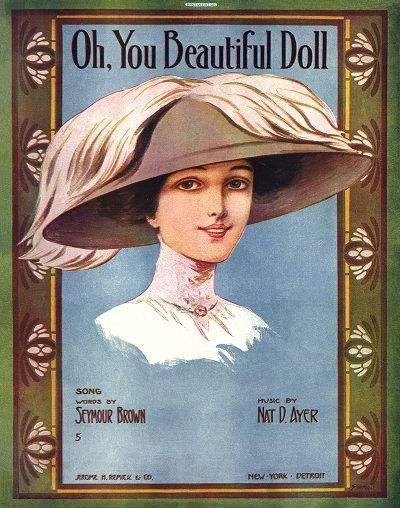
Example of Jerome H. Remick's Sheet Music - Shown for illustrative Purposes Jerome graduated from the Detroit Business University in 1887, before joining the Whitney-Remick lumber firm, a family business started by his grandfather, Royal C. Remick. Jerome's interests, however, lay in the developing popular sheet music industry and in 1898 he bought out the small, struggling firm of Whitney-Warner Publishing Company in Detroit. He turned the company into an extraordinarily successful sheet music publishing house. In 1902 Remick with associate Maurice Shapiro founded Shapiro-Remick & Company, selling several million copies in 1905 of the enormously successful "In the Shade of the Old Apple Tree," written by Harry Williams and Egbert van Alstyne. The partnership was dissolved in 1906, and Remick started his own firm Jerome H. Remick & Co. Van Alstyne continued with Remick and a string of hits followed including "Pretty Baby" and "Your Eyes have Told Me So." Remick's published songs influenced popular music trends, and included hundreds of hits such as "Baby Face," "I'm Looking Over a Four Leaf Clover," "Oh, You Beautiful Doll" and "Bye Bye Blackbird," all of which contributed greatly to American heritage and culture. In 1909 the company published three ballads that sold more than a million copies - "Put On Your Old Grey Bonnet.", "Moonlight Bay" in 1912 and "When You Wore A Tulip" in 1914. The firm also published ragtime music such as "Dill Pickles Rag" and "Black and White Rag". George Gershwin joined Remick in 1914 and composed many songs, but left the firm shortly after they published "Rialto Ripples" in 1917. To stay competitive Remick began to sign up unknown writers such as Harry Warren, Al Dubin, Gus Kahn and Richard A. Whiting, ushering in the golden era of the Roaring Twenties music. Changes were in the air, though. The arrival of talking pictures obliged Warner Brothers to invest in publishing houses, leading to their acquisition of Jerome H. Remick and Company in 1929, gaining Remick's catalogue and staff writers, including Harry Warren and Al Dubin who created hits such as "42nd Street" and "I Only Have Eyes For You." While competing publishing houses were located in Michigan, New York City and Chicago, Jerome H. Remick & Co. held sway in Detroit, also running a successful printing plant from there. The firm maintained branch offices in New York City and Chicago, with agencies all over the world, and started hundreds of music outlets under the name Remick Song Shops throughout the United States. Oddly, Remick could not read music at all, but had a natural understanding of public tastes. Remick was an enthusiastic gentleman farmer, and owned a 2 200 acre estate on Gratiot Avenue, growing fruit and vegetables, and raising chickens. His livestock included a herd of prize Holsteins, leading to a controlling interest in the Detroit Creamery Co. Remick was one of the influential patrons of the Detroit Symphony, repeatedly serving as President. His fundraising helped to create Orchestra Hall in 1919. His contributions also enabled the expansion of Detroit's orchestra to 90 players so as to persuade Ossip Gabrilowitsch, Mark Twain's son-in-law, to become Detroit Symphony's conductor. Remick also served as director on the Boards of the pharmaceutical firm, Parke-Davis & Co., the Paige Motor Co., the Detroit Savings Bank, and the Union Trust Co. He also acted as secretary of the Whitney Land Co., which operated in Oregon and he had an interest in the Detroit Free Press. He was president of the Big Four Gold and Copper Mining Co. in Colorado, owning claims covering 11 acres north of the Little Jonnie Mine in the Leadville district. History from Wikipedia and OldCompany.com (old stock certificate research service).
Compendium of History and Biography of the City of Detroit and Wayne County ... By Clarence Monroe Burton in 1909 JEROME HOSMER REMICK. Capitalist, publisher, man of affairs, and one of the most widely known and popular of Detroit's native sons; founder of the great publishing house of Jerome H. Remick & Company, of which he is the president and general manager and through whose genius as constructive and administrative executive the business of the company has been expanded until they are to-day the largest publishers and retailers of sheet music in the world, Jerome Hosmer Remick was born in Detroit, Michigan, on the 15th of November, 1868, a son of the late James Albert and Mary (Hosmer) Remick. In this compilation is entered a memoir to his grandfather, late Royal Clark Remick, to which the reader is referred for information concerning the family, whose founding in America dates from the early Colonial period. Jerome Hosmer Remick gained his educational training in the public schools of Detroit, later attending the old Legget (private) school, and was graduated from the Detroit Business University in 1887. He acquired his first experience in commercial affairs as an employe of the Commercial National Bank of Detroit, serving in the capacity of messenger. In 1888 he entered the employ of the firm of Whitney & Remick, one of the most important of Michigan's lumbering concerns and one of which his grandfather was one of the founders and his father the manager of the operative and transportation departments. During his connection with this firm he filled the respective positions of sealer, timekeeper, bookkeeper and supply-purchasing agent for the firm's lumber camps in Isabella and adjoining counties. Four years covered his service with this industry, and in 1892, in company with his father, he made an extended tour of the Old World, returning to Detroit in 1893. On the 2d of January, 1894, he was elected secretary of the Home Building & Loan Association of Detroit, an office he filled with credit to himself and the institution. In January, 1896, he was appointed trustee of the Detroit Chamber of Commerce, and he was actively concerned in its affairs in this official capacity for two years. In 1898 Mr. Remick purchased a half interest in the Whitney-Warner Publishing Company, of Detroit, entering a field in which, ten years later, he was to become the largest publisher of sheet music in the world. His connection with this enterprise, at that time one of modest extent and reputation, was that of direction and management, and the policies he initiated and the methods he inaugurated resulted in an immediate expansion of the business. In 1900 he became the sole owner of the enterprise, and with the exception of a small interest which he disposed of and shortly afterward repurchased, held by George Engel and Emil Voelker, he conducted it, under its original title, until 1904. On January 1, 1904, the business was consolidated with that of a New York institution and the joint interests were incorporated under the laws of the state of New York as Shapiro, Remick & Company, with Maurice Shapiro, president, and Mr. Remick as secretary, treasurer and general manager. Mr. Shapiro's connection with the company ceased in December, 1904, and the business was reorganized and reincorporated as Jerome H. Remick & Company, with an authorized capital of two hundred thousand dollars, Mr. Remick being elected president and general manager. On January 10, 1907, he organized the J. H. Remick Printing Company, a subsidiary concern, for the purpose of printing a portion of the sheet music published by the parent institution. The company was incorporated with an authorized capital, of which Mr. Remick is owner of seventy-five per cent, and of which company he is the president. An article descriptive of the company and of the subsidiary institution is printed elsewhere in this work. Aside from his publishing interests Mr. Remick has valuable holdings in a number of financial* industrial and commercial enterprises of the city and state. He is a director in Oak Grove, at Flint, Michigan, a sanitarium for the treatment and cure of mental diseases, of which his father was the founder, and which is one of the foremost institutions of its character in America. He is a large stockholder and a director in the Detroit Creamery Company, which is the largest enterprise of its nature in Michigan and which is recognized as one of the most admirably conducted establishments in the country. A review of its growth and development appears on other pages of this volume. In politics Mr. Remick is aligned as a supporter of the principles and policies of the Republican party, in which he is an active and influential member. He is an ardent partisan in matters of local interest and has been generous in the matter of personal service and financial support in the campaigns of recent years. He is a member of the leading business, social and commercial organizations and his memberships include the Detroit Club, the Country Club, the Detroit Automobile Club, the St. Clair Fishing & Shooting Club, the Pointe Au Barques Association, the Michigan Chapter, Sons of the American Revolution, and the Detroit Board of Commerce. He is also a member of the celebrated Lamb's Club of New York city and he includes among his friends and acquaintances the celebrities of the musical and theatrical professions of both America and Europe. Mr. Remick has demonstrated in the development of the great enterprise of which, since its establishment, he has been the controlling spirit, an undeniable right to the title of captain of industry, and has displayed proofs of the possession of creative and administrative ability of the highest type. He is a progressive, industrious and democratic American, a loyal and public-spirited citizen, and holds a secure place in the esteem and confidence of the community. He has contributed in large measure to the material advancement of the city in whose still greater commercial and civic prestige he is a firm believer. Mr. Remick married on the 25th of June, 1895, Miss Adelaide Fenton McCreqry, daughter of Hon. William B. McCreery, of Flint, Michigan. They are the parents of two children,--Katherine, born April 3, 1897, and Jerome Hosmer Remick, Jr., born December 24, 1903-
John W. Henney The secretary of the company was John W. Henney. The Henney family had been in the wagon and buggy building business in Freeport since the late 1870s and by the early 1920s the Henney name was among America's best known in the funeral car trade. In the decade that followed, the company produced approximately 30 limousine and sedan passenger cars to custom order, as well as a production run of 50 sport phaetons designed by Herman Earl (whose previous credits included work with Haynes-Apperson, Schacht and Halladay, which were marketed on the West Coast). The Henney passenger cars were, like the Henney hearses, powered by six-cylinder Continental or eight-cylinder Lycoming engines. The sport phaeton run had occurred during the early Twenties. 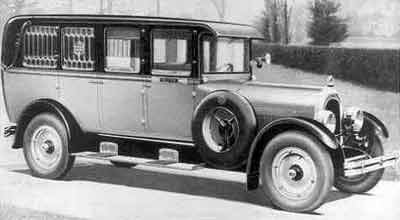
Example of Henney Motor Car - Shown for illustrative Purposes In 1929 Henney produced 100 taxicabs on stretched Model A Ford chassis--and in 1930-1931 came the Henney passenger car piece-de-resistance. It happened principally because John W. Henney, Jr. -- who had followed in his father's footsteps in the family business in 1912 -- was a good friend of Errett Lobban Cord's and was challenged to come up with a car equally as classy as those Cord was purveying in Indiana. The convertible sedan that resulted was a handsome thing, powered by a Lycoming straight-eight and set on a 137-1/2-inch wheelbase chassis, just like the new L-29 Cord. Only four examples were built and sold to friends or undertaking clients of Henney's. The last one was delivered in October 1931, and it was the final Henney passenger car as well. Henney Motor Company remained in the funeral car business (in addition to providing limousine bodies to Packard and producing a special run of Lincolns for the U.S. Government) until ceasing operations in 1954 and closing its doors forever the following year. The Henney related companyies we Henney Carriage Works - Henney Buggy Co. 1879 -1916, the John W. Henney Co. 1916-1927, and the Henney Motor Company 1927-1960 - Freeport, Illinois Jacob Henney came to Stephenson County first in the spring of 1848, bringing his family by team and wagon, since there was as yet no railroad. He did not like the country and returned to Pennsylvania that same fall. The Henneys were carriage makers in the East, among the first in the United States to introduce machinery into the manufacture of vehicles. In 1854 he brought his family back to Freeport by railroad and established a carriage repair shop in Cedarville, remaining there the rest of his life. John W. Henney, his son, was a boy of 12 when the family returned to stay. He learned the woodworker's trade, and carriage building and painting in his father's shop. He worked in several cities in the Midwest before becoming superintendent of the Wiley Carriage Shop in Kansas City. In 1868 he returned to Cedarville and took over the family shop, forerunner of the large business he was to develop over the years. He equipped it with the steam power and modern machinery, and the Henney vehicles soon established their reputation. In 1879 he reorganized the business as John W. Henney & Company and moved it to Freeport where there were railroad shipping facilities. The first Freeport plant was at South Chicago Avenue and West Jackson Street. John W. Henney, Jr. became superintendent of the plant in 1912, when he was 29. Mr. Henney's nephew, John Henney Smithe, recalled when the first plant was torn down to make way for a new building to fill the east half of the block between Chicago, Jackson, Van Buren and Spring Streets. The Henney Buggy Company was liquidated before the United States entered World War I and the building was sold to the Moline Plow Company, who enlarged the building to cover the rest of the block. The Moline Plow Company planned to make automobiles. Since the hand work in auto manufacturing at that was very similar to the work involved in carriage frames and upholstery, they retained most of the employees. The Moline Plow Company manufactured the Stephens motor car in Freeport from 1916 to 1924. John W. Henney, Jr. went back into business as the John W. Henney Co. in 1917, building truck bodies in the Maurer building on the railroad and the river bank. He also used the old Lena Casket Company building nearby (in East Freeport) to make walnut gun stocks for the government. When the Moline Plow Company liquidated the Stephens car operations in 1924, the Henney Company moved back into the building. The name of the business was changed to the Henney Motor Company in 1927 and its business was making motor hearses and later, ambulances. John W. Henney, Jr. sold out in 1928 before the stock market crash. He bought back in later and in 1931 was again head of the company, continuing until 1946, the year of his death. The company continued in business under other ownership from 1946 until it ceased operation in 1954. The business was closed out the following year. Over the years many of Freeport's most skilled craftsmen and much executive talent were developed in the Henney Buggy and the Henney Motor Companies. History from the Freeport Historical Society. In 1912 Henney's son and namesake, John W. Henney, Jr. became superintendent of the busy plant at the age of 29. A new larger plant was constructed that totally filled half of a city block, but his timing was unfortunate as the golden age of carriage building was coming to an end. Now called the Henney Buggy Company, the firm was eventually liquidated and the modern factory sold to the Moline Plow Company in 1915. Moline enlarged the plant and built the Stephens Salient Six automobile there from 1916 to 1924. With plenty of cash in hand, young John W. Henney, Jr. was soon back in business as the John W. Henney Co. after purchasing the former Maurer building which was conveniently located between the Illinois Central Railroad lines and the Pacotonica River. Early production consisted of truck bodies and a motorized Henney funeral coach was added late in 1916, built on an assembled chassis with a six-cylinder Continental engine. Henney also purchased the building now known as the Lena Casket Company in East Freeport to make wooden frames for the coach bodies as well as walnut gun stocks for the US Army. By the early 1920s the Henney name was among America's best known in the funeral car trade. In the decade that followed, the company produced approximately 30 limousine and sedan passenger cars to custom order, as well as a production run of 50 sport phaetons in the early 20s that were designed by Herman Earl (1878-1957) whose previous credits included work with Haynes-Apperson, Schacht and Halladay. He later worked for Des Moines Casket Company, and finally ended up in Piqua Ohio with the Meteor Motor Car Company where he worked for almost 25 years up to his retirement. The Henney passenger cars were, like the Henney hearses, powered by six-cylinder Continental or eight-cylinder Lycoming engines. The 1923 Henney catalog showed a handsome light-grey 12-column carved-panel funeral coach built on a light truck chassis which featured huge nickel-plated disc wheels. History from OldCompany.com (old stock certificate research service).
Certificate Vignette
John W. Henney's Signature as Secretary
Jerome H. Remick's Signature as President
John W. Henney, Jr.'s Signature on Back
Certificate Ledger Stub referring to Freeport, Illinois
Example of Jerome H. Remick's Sheet Music - Shown for illustrative Purposes
Example of Jerome H. Remick's Sheet Music - Shown for illustrative Purposes
Example of Jerome H. Remick's Sheet Music - Shown for illustrative Purposes
Example of Jerome H. Remick's Sheet Music - Shown for illustrative Purposes
Compendium of History and Biography of the City of Detroit and Wayne County ... By Clarence Monroe Burton in 1909 JEROME HOSMER REMICK. Capitalist, publisher, man of affairs, and one of the most widely known and popular of Detroit's native sons; founder of the great publishing house of Jerome H. Remick & Company, of which he is the president and general manager and through whose genius as constructive and administrative executive the business of the company has been expanded until they are to-day the largest publishers and retailers of sheet music in the world, Jerome Hosmer Remick was born in Detroit, Michigan, on the 15th of November, 1868, a son of the late James Albert and Mary (Hosmer) Remick. In this compilation is entered a memoir to his grandfather, late Royal Clark Remick, to which the reader is referred for information concerning the family, whose founding in America dates from the early Colonial period. Jerome Hosmer Remick gained his educational training in the public schools of Detroit, later attending the old Legget (private) school, and was graduated from the Detroit Business University in 1887. He acquired his first experience in commercial affairs as an employe of the Commercial National Bank of Detroit, serving in the capacity of messenger. In 1888 he entered the employ of the firm of Whitney & Remick, one of the most important of Michigan's lumbering concerns and one of which his grandfather was one of the founders and his father the manager of the operative and transportation departments. During his connection with this firm he filled the respective positions of sealer, timekeeper, bookkeeper and supply-purchasing agent for the firm's lumber camps in Isabella and adjoining counties. Four years covered his service with this industry, and in 1892, in company with his father, he made an extended tour of the Old World, returning to Detroit in 1893. On the 2d of January, 1894, he was elected secretary of the Home Building & Loan Association of Detroit, an office he filled with credit to himself and the institution. In January, 1896, he was appointed trustee of the Detroit Chamber of Commerce, and he was actively concerned in its affairs in this official capacity for two years. In 1898 Mr. Remick purchased a half interest in the Whitney-Warner Publishing Company, of Detroit, entering a field in which, ten years later, he was to become the largest publisher of sheet music in the world. His connection with this enterprise, at that time one of modest extent and reputation, was that of direction and management, and the policies he initiated and the methods he inaugurated resulted in an immediate expansion of the business. In 1900 he became the sole owner of the enterprise, and with the exception of a small interest which he disposed of and shortly afterward repurchased, held by George Engel and Emil Voelker, he conducted it, under its original title, until 1904. On January 1, 1904, the business was consolidated with that of a New York institution and the joint interests were incorporated under the laws of the state of New York as Shapiro, Remick & Company, with Maurice Shapiro, president, and Mr. Remick as secretary, treasurer and general manager. Mr. Shapiro's connection with the company ceased in December, 1904, and the business was reorganized and reincorporated as Jerome H. Remick & Company, with an authorized capital of two hundred thousand dollars, Mr. Remick being elected president and general manager. On January 10, 1907, he organized the J. H. Remick Printing Company, a subsidiary concern, for the purpose of printing a portion of the sheet music published by the parent institution. The company was incorporated with an authorized capital, of which Mr. Remick is owner of seventy-five per cent, and of which company he is the president. An article descriptive of the company and of the subsidiary institution is printed elsewhere in this work. Aside from his publishing interests Mr. Remick has valuable holdings in a number of financial* industrial and commercial enterprises of the city and state. He is a director in Oak Grove, at Flint, Michigan, a sanitarium for the treatment and cure of mental diseases, of which his father was the founder, and which is one of the foremost institutions of its character in America. He is a large stockholder and a director in the Detroit Creamery Company, which is the largest enterprise of its nature in Michigan and which is recognized as one of the most admirably conducted establishments in the country. A review of its growth and development appears on other pages of this volume. In politics Mr. Remick is aligned as a supporter of the principles and policies of the Republican party, in which he is an active and influential member. He is an ardent partisan in matters of local interest and has been generous in the matter of personal service and financial support in the campaigns of recent years. He is a member of the leading business, social and commercial organizations and his memberships include the Detroit Club, the Country Club, the Detroit Automobile Club, the St. Clair Fishing & Shooting Club, the Pointe Au Barques Association, the Michigan Chapter, Sons of the American Revolution, and the Detroit Board of Commerce. He is also a member of the celebrated Lamb's Club of New York city and he includes among his friends and acquaintances the celebrities of the musical and theatrical professions of both America and Europe. Mr. Remick has demonstrated in the development of the great enterprise of which, since its establishment, he has been the controlling spirit, an undeniable right to the title of captain of industry, and has displayed proofs of the possession of creative and administrative ability of the highest type. He is a progressive, industrious and democratic American, a loyal and public-spirited citizen, and holds a secure place in the esteem and confidence of the community. He has contributed in large measure to the material advancement of the city in whose still greater commercial and civic prestige he is a firm believer. Mr. Remick married on the 25th of June, 1895, Miss Adelaide Fenton McCreqry, daughter of Hon. William B. McCreery, of Flint, Michigan. They are the parents of two children,--Katherine, born April 3, 1897, and Jerome Hosmer Remick, Jr., born December 24, 1903-
John W. Henney The secretary of the company was John W. Henney. The Henney family had been in the wagon and buggy building business in Freeport since the late 1870s and by the early 1920s the Henney name was among America's best known in the funeral car trade. In the decade that followed, the company produced approximately 30 limousine and sedan passenger cars to custom order, as well as a production run of 50 sport phaetons designed by Herman Earl (whose previous credits included work with Haynes-Apperson, Schacht and Halladay, which were marketed on the West Coast). The Henney passenger cars were, like the Henney hearses, powered by six-cylinder Continental or eight-cylinder Lycoming engines. The sport phaeton run had occurred during the early Twenties.
Example of Henney Motor Car - Shown for illustrative Purposes